
America’s Next Strategic Advantage Is Logistics Speed
By Rick Moore, Retired Deputy Chief of Staff for Plans and Programs, US Air Force
The United States has long measured military advantage in terms of platforms and firepower. We count aircraft, ships, and munitions. We debate range, survivability, and lethality.
But in today’s operating environment, a different variable is increasingly decisive: time.
Not time in the abstract, but time measured in how quickly combat power can be moved, assembled, and made operational. In an era defined by contested logistics, distributed operations, and rapidly shifting threats, logistics timelines are no longer a supporting consideration. They are becoming the pacing constraint.
A Growing Airlift Gap
The U.S. strategic airlift fleet remains highly capable, but it is also aging and constrained by design assumptions that date back decades. The core aircraft that underpin global mobility were built for a different set of requirements, with cargo dimensions and operating concepts rooted in Cold War-era needs.
That mismatch is becoming more pronounced.
Modern military systems, whether advanced rotorcraft, integrated command-and-control nodes, or large-scale autonomous systems, are increasingly defined by their size and complexity. They are not designed to be routinely disassembled for transport. Yet that is often exactly what current logistics processes require.
The result is a persistent operational gap. Critical systems must be broken down, moved across multiple transport modes, and then reassembled and tested before they can be used. This process can take weeks. During that time, those assets are unavailable for operations.
This is not simply an efficiency issue. It is a readiness issue.
Recent analyses have pointed to a widening gap between what the United States needs to move and how quickly it can move it. Traditional approaches to closing that gap rely on large, government-led acquisition programs that may not fully deliver capability until the 2040s.
Those programs are essential. But they will not address near-term operational constraints on their own.
The Limitation Is Volume, Not Just Weight
Much of the current discussion around airlift focuses on payload capacity and fleet size. Those metrics matter, but they do not capture the full problem.
In practice, many outsized military systems reach the dimensional limits of existing aircraft before they approach weight limits. The constraint is not how heavy the cargo is. It is whether it physically fits.
That distinction has operational consequences. It is what forces disassembly, drives multi-step logistics chains, and extends deployment timelines.
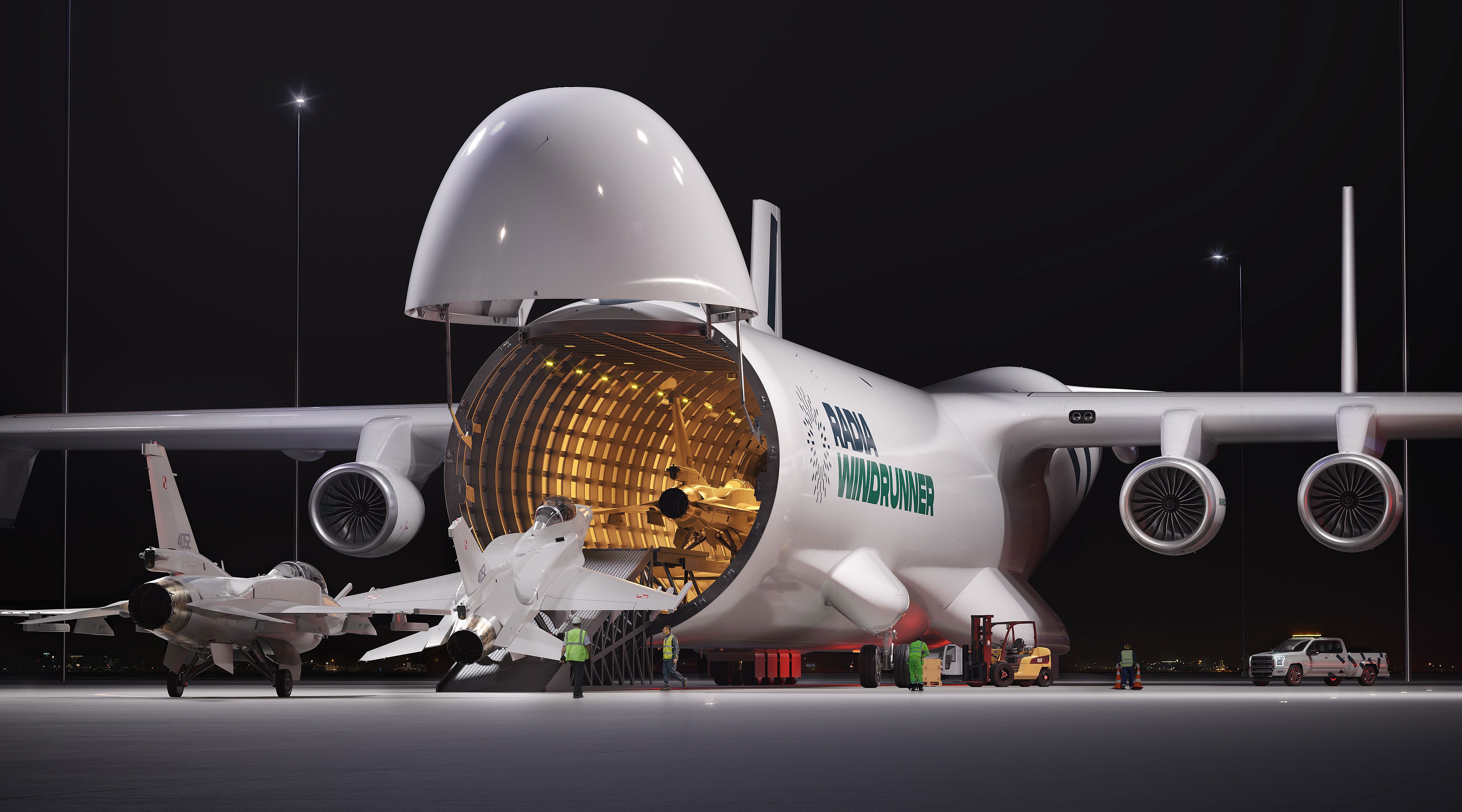
A different approach to airlift, one that prioritizes volume alongside payload, would enable transport of complete, operational systems. Instead of moving parts, it would move capability.
The implications are significant. Transporting intact systems could compress deployment timelines from weeks to days in certain scenarios, while reducing the logistical burden associated with reassembly and testing.
Requirements Reflect the Past
One of the challenges in evaluating new logistics capabilities is that formal requirements tend to reflect historical constraints.
If a system cannot currently be transported intact, there is typically no requirement to do so. Over time, that absence of requirement can be interpreted as an absence of need.
But operational experience suggests otherwise.
Today’s deployment processes are often accepted because they are familiar, not because they are optimal. Doctrine, planning assumptions, and acquisition frameworks have evolved around those constraints.
New capabilities invite a different question: what would requirements look like if those constraints no longer applied?
That question is not always comfortable. It challenges long-standing assumptions about how mobility is planned and executed. But it is necessary if the United States is to fully leverage emerging technologies and concepts.
A Portfolio Approach to Airlift
The debate over strategic airlift is often framed as a choice between sustaining the current fleet and investing in future programs.
That framing is incomplete.
A more effective approach is to think in terms of a portfolio that combines long-term modernization with near-term, complementary capability. This is not about replacing existing programs. It is about bridging the gap between current limitations and future solutions.
Alternative development models, including commercially driven and dual-use approaches, suggest that meaningful capability could be fielded on accelerated timelines and with different cost structures.
These approaches are not substitutes for traditional acquisition. They are complements that can reduce pressure on existing fleets and provide additional flexibility in how capability is delivered.
Logistics Speed as Deterrence
This discussion is ultimately about more than logistics. It is about deterrence.
Deterrence depends not only on what a military can do, but on how quickly it can do it. The ability to move complete, mission-ready systems into theater on short timelines affects how adversaries assess risk and how allies assess credibility.
Speed changes the calculus.
It enables faster response, greater operational flexibility, and more resilient force posture. It also reduces the periods during which critical assets are unavailable due to transit and reassembly.
In that sense, logistics speed is itself a form of capability.
A Near-Term Opportunity
The United States is entering a transitional period in strategic airlift. Existing platforms will continue to operate, but with increasing sustainment demands. Future systems will eventually provide new capability, but not on timelines that address current gaps.
That creates an opportunity.
Bridging capabilities that expand what can be transported and reduce the time required to deploy it can have an outsized impact in the near term. They can improve readiness, ease strain on the current fleet, and enable new operational concepts aligned with distributed and contested environments.
Realizing that opportunity will require a shift in perspective. It will require evaluating new approaches on their operational merits, rather than through the lens of legacy constraints.
The next strategic advantage may not come from a new weapon system alone. It may come from the ability to move the systems we already have faster, more efficiently, and without compromise.
That is a challenge the United States can address now, rather than waiting decades to solve.